
Why L&D Teams Avoid ROI Measurement and How to Make It Stick
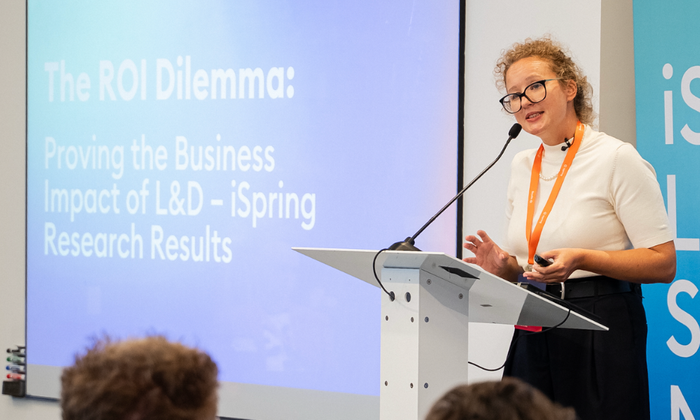
What if the L&D community has overestimated how much of the training ROI problem can be solved with better methodology?
L&D certainly needs good metrics, baselines, and access to business data. But after surveying more than 140 learning professionals and talking with practitioners who have spent years doing this work, I’m not convinced another framework might be the best way to go.
Just think about it: only 11% of respondents in our 2026 ROI study can quantitatively connect training to a business result, and the number has barely moved since last year. So, if L&D already knows what good measurement looks like, what keeps getting in the way? Remarkably, the research repeatedly pointed to less technical and more human patterns like hesitation, self-protection, and the urge to keep measurement at a safe distance.
Let’s look at where ROI resistance tends to show up, why it can be so easy to rationalise, and what teams can do to make measurement easier to sustain.
The ROI pressure is mounting. So why aren’t we preparing for it?
One of the peculiar findings of our ROI research was what we called the Passivity Paradox.
41% of respondents expect pressure to prove ROI or defend the L&D budget. They already know someone is likely to ask the big-number questions, yet they aren’t preparing for the conversation. Among this group, 60% said they lacked time or that ROI was still a low priority.
I don’t think the lack of time argument should be dismissed as an excuse. L&D teams are busy, often genuinely overloaded, and measurement is rarely the only thing competing for attention. But the contradiction is still interesting. We already expect greater scrutiny but ROI continues to slide down the list.
Passivity Paradox creates a pretty dangerous delay: measurement becomes urgent only when accountability is a high-stakes deal. By then, some of the evidence you would want, like a baseline, a clearly agreed KPI, and manager observations, may already be impossible to recreate properly.
This is where the ROI research became more interesting for our team because some practitioners suggested that timing and workload weren’t the only reasons measurement gets postponed.
Measurement can reveal things L&D would rather not hear
Two experts in our research named the issue very directly. Holly Burkett talked about resistance to measurement driven by concerns about negative results. Giuseppe Papotto described a fear of measuring results at all. I think this deserves more space in the ROI conversation.
- Measurement can tell us that a program didn’t work as expected.
- It can show that the business result improved, but the evidence isn’t strong enough to credit training for the change.
- It can reveal that the original diagnosis was off, or that the intervention we spent months developing was aimed at the wrong part of the problem.
Experienced L&D professionals already know these outcomes are possible, but that doesn’t make them any easier to face.
We care about the programs we build, the budgets attached to them, and, no less importantly, our credibility with the business. It makes us human and is totally normal. The trouble starts when protecting the program (and your reputation) becomes more important than testing it properly or looking at it objectively.
Where ROI resistance shows up and how to overcome it
Our study found six practices that appear far more consistently among teams that can demonstrate business impact:
- Defining the business result upfront.
- Setting a baseline.
- Involving line managers.
- Connecting learning with business data.
- Reviewing and iterating.
- Reporting results honestly.
Originally, resistance seemed most obvious at the end of this chain, when a team has a disappointing result and has to decide how to report it.
But by that point, resistance may already have shaped the entire evidence base, including which KPI was chosen, whether a baseline existed, which data was collected, and whether the program was ever seriously challenged after launch.
This pushed us to think less about teaching the mechanics of ROI and more about helping L&D teams make good measurement easier to stick with. The good news is, these are small, easy-to-implement steps.
- If defining a business target feels like asking L&D to make a promise it can’t fully control, treat the target as a shared hypothesis with the stakeholder who owns the problem. Agree on what you expect to change and what training can reasonably influence, then test the assumption together.
- If the training solution already has momentum, use the baseline to verify the problem itself. Current error rates, conversion data, or performance figures can show whether the issue is widespread, where it is concentrated, and whether training is actually the right response. This may lead you to narrow the program, redesign it, or avoid unnecessary training altogether.
- If manager involvement feels too broad, shrink the ask. One manager, one observable behavior, one checkpoint after training. This is much easier to act on and gives L&D evidence the LMS cannot.
- If business data feels intimidating, review it with the person who already works with that metric every day. If you’re looking at conversion, that might be Sales; if it’s error rates, Operations; if it’s cost, Finance. Their role is to help L&D understand what else may have influenced the number (seasonality, staffing changes, process changes, pricing, or other factors) so the team can judge the result fairly.
- If a program underperforms after months of development, try reviewing it as if you inherited it from another team. A little distance can make it much easier to ask what you would keep, question, or change based on the result.
- And at the final reporting stage, I like one very simple private question: What am I protecting? The program? The budget? My own credibility? Any of these concerns may be completely legitimate. But you need to make sure they don’t distort the result.
Partial ROI proof can be a sign of measurement maturity
Another interesting study finding came from the 40% of respondents who said they could prove business impact only partially.
Their responses were longer and more specific about what they could show and what they couldn’t. These practitioners named real gaps in their process, from attribution and missing business data to methodology.
What might initially sound like failure is actually a sign of a mature team that knows where it stands. In other words, ROI work gets healthier when we stop expecting every measurement exercise to produce a clean success story. A meaningful result may mean changing the intervention, being honest that the data shows correlation rather than causation, or recognising that the evidence is still too weak to support a firm conclusion.
Final word
I don’t think resistance to ROI measurement will disappear, and I’m not sure this is a realistic goal anyway. The realities of L&D aren’t going away, and we’ll have to face tight deadlines, imperfect data, and people being invested in the work they’ve built.
What we can do is build measurement practices that account for these realities instead of pretending they don’t exist. If we make the challenging aspects of ROI measurement easier to face, imperfect reports and less-than-ideal results won’t be so intimidating, both for L&D teams and stakeholders. And that may be what finally helps us move beyond the stubborn 11%.
Maria Starling
L&D Community Lead at iSpring